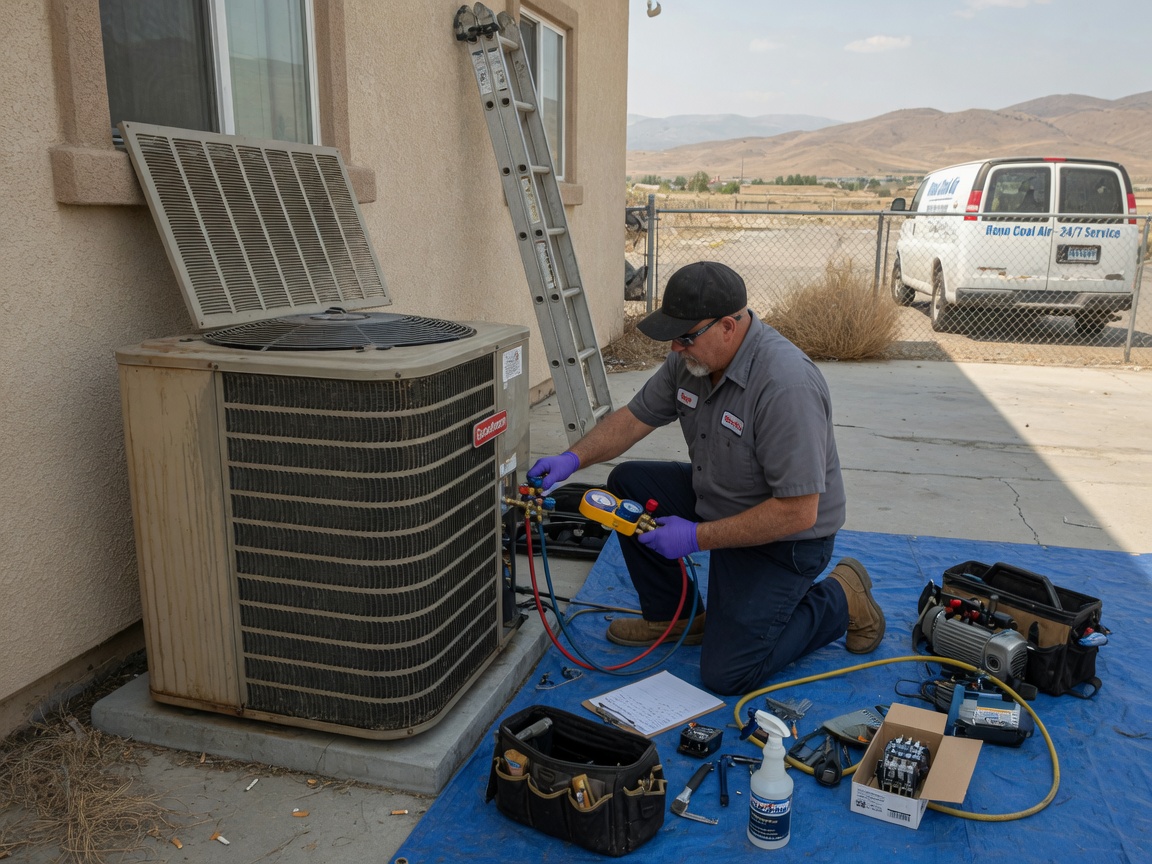
Reno’s high desert climate brings intense summer heat that pushes older air conditioning systems in neighborhoods like Old Southwest and Midtown to their limits. Homes built before 1990 often have single-stage units with undersized ductwork that struggle when temperatures climb and fine alkali dust from the surrounding basin coats condenser coils. Technicians must clean coils thoroughly and check for restricted airflow caused by years of accumulated grit that standard filters miss. Washoe County code requires proper refrigerant handling and leak documentation on every job, so any repair starts with a full pressure test before adding R-410A or R-22.
In newer developments such as Damonte Ranch and Somersett, two-stage and variable-speed systems are common but still fail when capacitors weaken under daily 100-degree swings. Access to rooftop units on single-story ranch homes in Caughlin Ranch can be straightforward, yet hillside properties require extra safety measures for ladder placement on sloped driveways. Technicians carry extra contactors and fan motors because the combination of dry heat and occasional monsoon moisture accelerates electrical wear. Carson City and Sparks customers face the same conditions, so parts commonality across the region keeps most repairs completed the same day.
Upfront diagnostic findings are shared before any parts are ordered, and homeowners receive photos of the failed component. This prevents surprises on jobs where a simple capacitor replacement reveals a failing compressor that has been short-cycling due to low refrigerant from a slow leak at a flare fitting. The address at 5601 Echo Ave allows quick dispatch across Reno and Sparks regardless of time of day or night.
Technician insight
In Reno the thing that catches most people out with AC repair is how quickly the fine dust from the high desert settles inside the condenser and evaporator coils. Homes near the Truckee River or in lower Midtown see this faster than hillside properties in Caughlin Ranch, and skipping annual coil cleaning turns a $200 service call into a compressor replacement.
Midtown Home With No Cooling At 102 Degrees
A 1980s single-story home in Midtown lost cooling on the hottest day of the year. The diagnostic showed a failed run capacitor and low refrigerant from a pinhole leak at the outdoor service valve. The capacitor was replaced, the leak was repaired, the system was recharged, and the home reached 74 degrees within two hours.
AC Repair Services We Offer
✓Refrigerant Leak Detection and Repair
Electronic leak detection and nitrogen pressure testing locate leaks in lines running through attics common in Midtown and Old Southwest homes before recharging the system.
✓Capacitor and Contactor Replacement
Failed start capacitors and welded contactors are swapped on the spot to restore compressor and fan operation during peak summer loads.
✓Condenser Coil Cleaning
High-pressure washing and fin straightening remove the fine dust layer that builds rapidly in Reno’s high desert, restoring heat transfer efficiency.
✓Thermostat Replacement and Calibration
Programmable and smart thermostat installs correct short-cycling issues caused by inaccurate sensors in older homes throughout Caughlin Ranch.
✓Emergency AC Breakdown Service
24/7 response for complete loss of cooling in Washoe County homes when daytime highs exceed 95 degrees and indoor temperatures climb quickly.
AC Repair Cost in Reno, NV
| Service | Typical Range | What Affects It |
|---|---|---|
| Diagnostic Visit | $99–$150 | Waived if repair is approved; higher after 8 pm or on holidays |
| Capacitor Replacement | $180–$320 | Dual-run capacitors on two-stage units cost more |
| Refrigerant Leak Repair | $350–$750 | Depends on leak location and whether line set replacement is needed |
| Condenser Coil Cleaning | $150–$250 | Heavy alkali buildup or fin damage increases time required |
Ranges are typical for Reno, NV and confirmed with an exact written quote before any work starts.
How it works
- 1
Phone Intake And Dispatch
Details about the home’s age, neighborhood, and symptoms are collected so the correct parts and tools arrive on the first visit.
- 2
On-Site Diagnostic
Voltage, amperage, pressures, and temperatures are recorded while the system runs to isolate the exact failure point.
- 3
Findings Review
The homeowner sees photos and receives a clear explanation of what failed and the options to restore cooling.
- 4
Repair And Verification
Parts are replaced, the system is tested under load, and final readings confirm proper operation before departure.
Pricing
Upfront quotes are provided after the diagnostic and before any repair work begins.